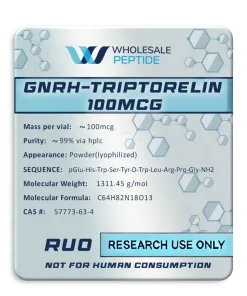
GnRH-Triptorelin 100mcg
$29.99

Buy GnRH at Wholesale Peptide
Gonadotropin releasing hormone is the backbone of reproductive endocrinology research, a critical regulatory peptide hormone in vertebrate reproductive systems. When research institutions want to buy gnrh for their lab research, the quality and purity of the peptide is key to the experiment’s success. This guide covers the molecular properties, research applications and sourcing options for this essential research compound.
Research shows that GnRH as a hypothalamic peptide hormone is vital for studying reproductive physiology, endocrine signaling pathways and hormone responsive cancers. Understanding its properties and applications helps researchers make informed decisions when choosing suppliers for their lab research.
Molecular Structure of GnRH
The gonadotropin releasing hormone gnrh is a decapeptide with a specific amino acid sequence that determines its biological activity in research. The molecular structure of this peptide hormone has been refined over millions of years in vertebrate reproductive systems.
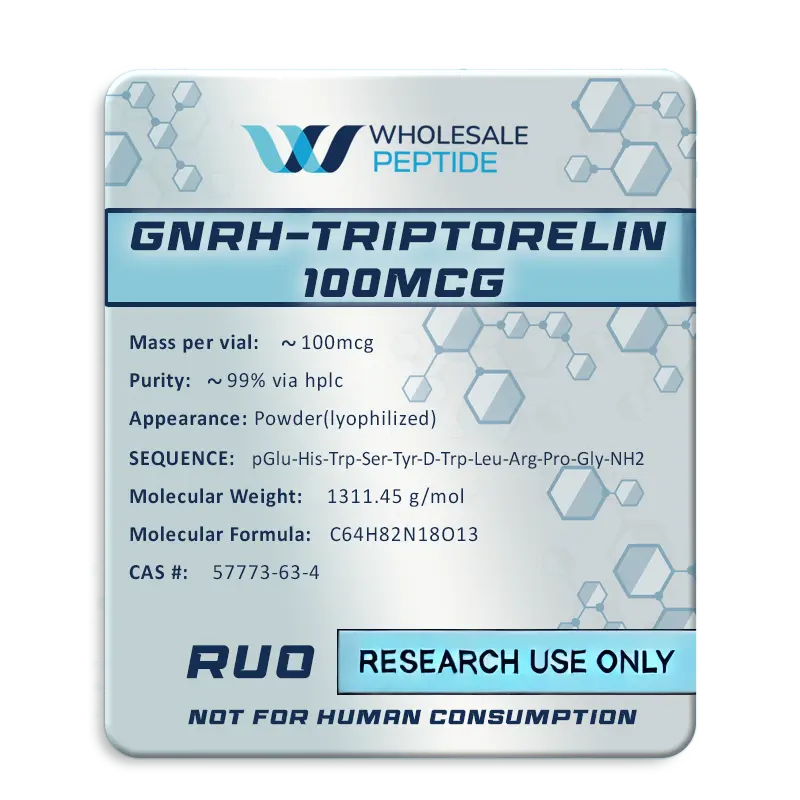
Amino Sequence: Pyr-His-Trp-Ser-Tyr-Gly-Leu-Arg-Pro-Gly-NH2
Molecular formula: C55H75N17O13
Molecular Weight: 1182.2 g/mol
Pubchem CID: 638678
CAS #: 71447-49-9
The structure has several critical elements that research has identified as essential for receptor binding and biological stability. The pyroglutamic acid at the N-terminus protects against aminopeptidase degradation while the amidated C-terminal glycine (Gly-NH2) confers resistance to carboxypeptidases. These modifications help maintain peptide integrity during experiments and storage.
Research shows that even minor changes to this sequence can drastically affect receptor binding affinity and downstream signaling cascades. The aromatic amino acids tryptophan and tyrosine contribute to the peptide’s conformational stability while the basic residues histidine and arginine facilitate electrostatic interactions with gnrh receptors.
Mechanism of Action
The luteinizing hormone releasing hormone binds to specific gnrh receptors on anterior pituitary gonadotrope cells. Research shows this interaction triggers multiple intracellular cascades that ultimately regulate the secretion of gonadotropins luteinizing hormone and follicle stimulating hormone.Upon binding to the receptor, the gonadotropin releasing hormone agonist effect activates G-protein coupled signaling pathways. The primary pathway involves Gq/11 proteins which stimulate phospholipase C and increase intracellular calcium. This calcium mobilization drives the synthesis and release of luteinizing hormone and follicle stimulating hormone from the anterior pituitary.
Research shows that GnRH also engages Gs and Gi protein pathways, modulating cyclic adenosine monophosphate levels and gene transcription. Additional signaling involves soluble and particulate guanylyl cyclases, producing cyclic guanosine monophosphate and interacting with nitric oxide pathways.
The pituitary response depends critically on the pulsatile nature of GnRH release from the hypothalamus. Continuous exposure to gnrh agonists paradoxically inhibits gonadotropin secretion through receptor desensitization, a phenomenon extensively studied in hormone responsive cancers and assisted reproduction research.
In experimental models, luteinizing hormone stimulates testosterone synthesis in testicular Leydig cells, while follicle stimulating hormones promote spermatogenesis through effects on Sertoli cells. In female models, these gonadotropins regulate ovarian follicle maturation, ovulation and estrogen synthesis throughout the menstrual cycle.
Research
Extensive laboratory research has established GnRH as a key tool for reproductive endocrinology research and therapeutic development. Studies over several decades have elucidated its role in various physiological and pathological conditions.
Research shows that synthetic gnrh and its analogues play critical roles in hormone dependent conditions. Investigations into prostate cancer treatment have used gnrh agonists to study androgen suppression, while breast cancer research has looked at gonadotropin suppression in estrogen dependent conditions.
Laboratory research use of GnRH has been instrumental in understanding precocious puberty mechanisms. Studies show that continuous administration of synthetic analogue compounds can suppress premature gonadotropin secretion, providing insights into normal pubertal development and its disorders.
Assisted reproduction research has extensively used GnRH and its analogues to study ovarian stimulation protocols. Research shows that controlled ovarian hyperstimulation using follicle stimulating hormone fsh with gnrh agonist or antagonist protocols can optimize oocyte retrieval in experimental models.Uterine fibroids research has benefited from GnRH research, with studies showing that estrogen suppression through gonadotropin inhibition can reduce fibroid growth in laboratory models. Similar approaches have been applied to endometriosis research where estrogen suppression provides insights into disease mechanisms.
Quantitative data from research studies shows that pulsatile GnRH can restore reproductive function in experimental models of hypothalamic amenorrhea. Continuous synthetic gnrh therapy can achieve profound gonadotropin suppression within 2-4 weeks in laboratory settings, demonstrating the compound’s potency.
Storage and Safety
Proper handling and storage protocols are crucial for maintaining GnRH peptide integrity in research applications. The compound’s inherent instability requires specific environmental controls to preserve its biological activity and experimental reproducibility.
Research grade GnRH should be stored desiccated at -20°C or below, protected from light and moisture. Lyophilized triptorelin and other synthetic analogues show enhanced stability under these conditions. Once reconstituted in aqueous solutions, aliquots should be stored at 4°C for short term use or -20°C for long term storage.
Freeze thaw cycles pose significant risk to peptide integrity and should be minimized during experimental protocols. Research shows that repeated temperature fluctuations can cause peptide aggregation and reduced biological activity. When preparing working solutions, researchers should consider using carrier protein additives to enhance stability in other aqueous solutions.
Laboratory research protocols must state that these compounds are for research use only. Products are not approved for diagnostic or therapeutic use in clinical settings. Proper personal protective equipment should be used during handling and waste disposal should follow institutional guidelines for research chemicals.
Temperature control is critical during shipping and storage transitions. Peptides shipped without temperature control may degrade and compromise experimental outcomes. Research institutions should verify storage conditions upon receipt and document any temperature excursions that may affect peptide quality.
Why Buy from Wholesale Peptide
When researchers need to buy gnrh for research, supplier selection is key to experimental success and regulatory compliance. Wholesale Peptide stands out through its comprehensive quality control measures and customer focused policies for research institutions.
The company’s third party testing ensures that every batch meets the purity standards for research use. HPLC analysis confirms peptide identity and purity levels typically above 98% providing the consistency required for reproducible results.Same day shipping for orders placed before 1pm EST ensures projects don’t get delayed and researchers get their compounds quickly. This is especially useful for time critical research or when unexpected experimental needs arise.
Quality documentation is included with every shipment so researchers can keep lab records and meet regulatory requirements. Institutions can access batch specific purity analysis to meet their quality control and publication standards.
30 day satisfaction guarantee gives research institutions extra peace of mind for research purchases. They can return unopened products if they don’t meet experimental requirements. This policy reflects the company’s confidence in their quality and commitment to customer satisfaction.
Competitive pricing makes high quality peptides accessible to research institutions with varying budgets. Volume discounts and institutional pricing options support larger research programs while meeting the quality standards for peer reviewed research.
Products from Wholesale Peptide are for Research Use Only
All products sold by Wholesale Peptide are research chemical only. This means the use of this chemical is strictly for in-vitro laboratory testing and experimentation. Human or veterinary use is strictly forbidden. This product is not a substance, food or cosmetic and may not be misbranded, mislabeled or misused as such.
Research institutions must comply with these guidelines to ensure legal and ethical use of purchased peptides. Documentation of intended research applications may be required to verify use within academic or commercial research settings.
The research use only designation protects both suppliers and research institutions from regulatory violations while allowing legitimate scientific research. Institutional review and approval processes should verify that proposed research applications comply with these restrictions.
Shipping Policy of Wholesale Peptide
Wholesale Peptide ships same day for orders placed before 1pm EST Monday through Friday. Orders placed after 1pm EST or on weekends will be shipped the next business day.
Temperature controlled shipping options are available to ensure peptide stability during transit especially for temperature sensitive compounds like GnRH. Tracking information is provided so researchers can track the shipment and plan for receipt.
Satisfaction Guarantee
Wholesale Peptide offers 30 day satisfaction guarantee on all products purchased from us. Simply return any unopened products to us for a full refund of the purchase price of the unused products.
This guarantee gives research institutions confidence in their purchasing decisions and access to high quality peptides for critical research applications. The policy allows risk free procurement for labs starting new research protocols or testing supplier quality.
Third Party Testing of Every Batch
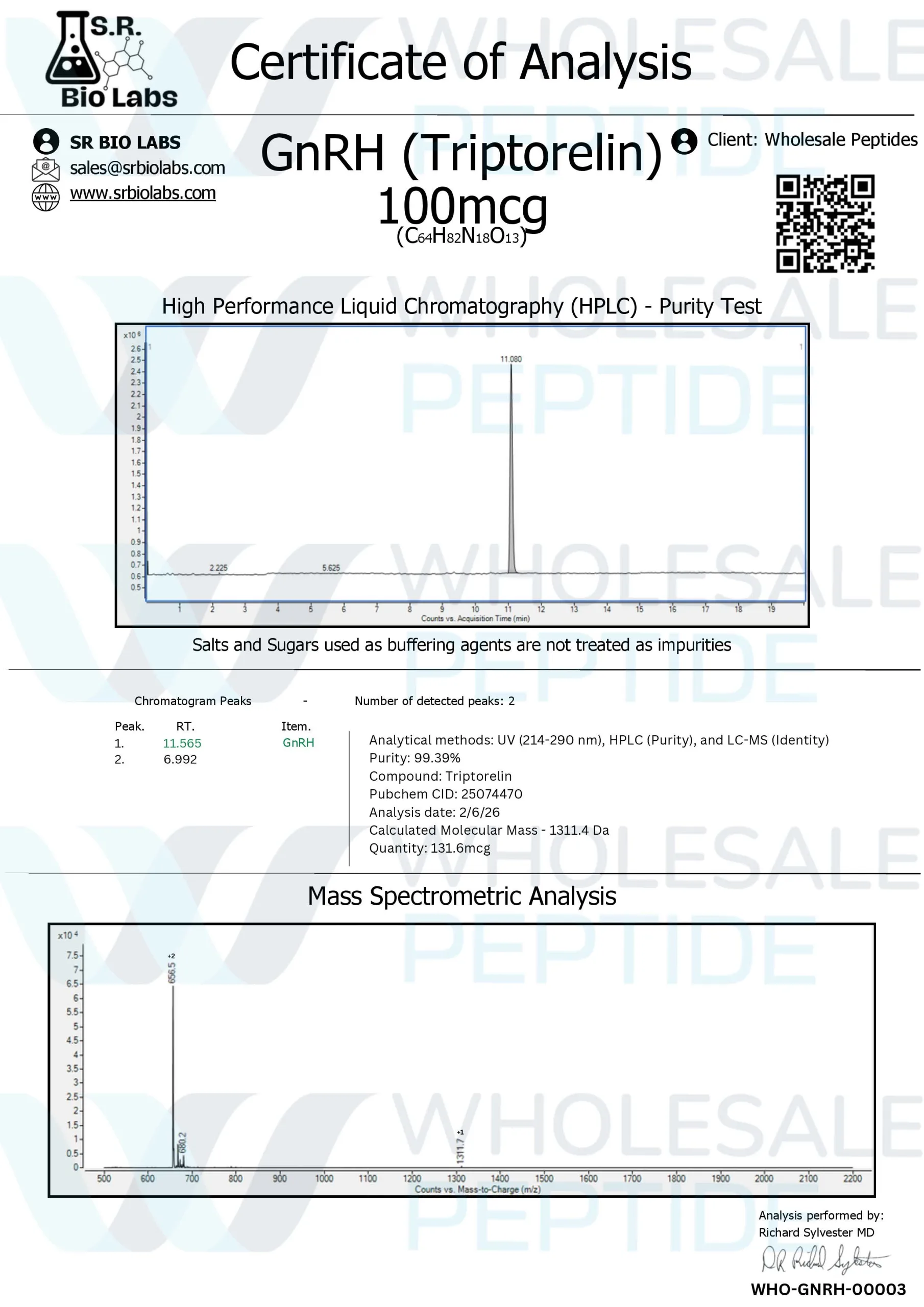
Every product sold by Wholesale Peptide is third party tested using HPLC to ensure product purity and accuracy.
Independent analysis provides objective quality control that supports research reproducibility and publication standards. Batch specific documentation allows researchers to keep complete records for regulatory compliance and experimental validation.
The testing protocol checks not only purity but also verifies peptide identity through mass spectrometry and other analytical methods. This comprehensive approach ensures researchers get exactly the compound they ordered for their research.
Research Applications and Future Directions
GnRH is becoming more versatile in laboratory research as new applications emerge across multiple disciplines. Current research trends show growing interest in its use as a model system for G-protein coupled receptor signaling and peptide hormone regulation.
Neuroscience research is using GnRH to study hypothalamic-pituitary interactions and neuroendocrine signaling pathways. Studies on the neural control of reproductive behavior are using synthetic gnrh analogues to manipulate gonadotropin secretion and measure downstream effects on neural activity.
Cancer research applications are evolving with studies into hormone responsive cancers examining new gnrh agonist formulations and delivery methods. Research suggests that understanding gnrh receptor expression in different tumor types may reveal new targets for future research.
Developmental biology research is using GnRH to study pubertal onset and reproductive system maturation. Laboratory models investigating the factors that control the onset of reproductive competence are using GnRH to manipulate the timing of pubertal events.
Conclusion
For research institutions looking to buy gnrh, Wholesale Peptide provides the quality control, analytical verification and customer support for successful research. The company’s third party testing, same day shipping and satisfaction guarantee creates a reliable supply chain for critical research compounds.
The molecular precision required for GnRH research demands suppliers who understand the technical requirements and regulatory constraints of research use. From storage protocols to analytical documentation, every aspect of peptide sourcing impacts experimental outcome and publication success.
Research is revealing new applications for this fundamental reproductive hormone so it will continue to be important in endocrinology, neuroscience and related fields. Institutions doing legitimate research can rely on Wholesale Peptide for consistent access to high quality research grade peptides that meet the strict requirements of modern research.
References
- Millar, R. P., Lu, Z. L., Pawson, A. J., Flanagan, C. A., Morgan, K., & Maudsley, S. R. (2004). Gonadotropin-releasing hormone receptors. Endocrine Reviews, 25(2), 235–275.
- Conn, P. M., & Crowley, W. F. (1994). Gonadotropin-releasing hormone and its analogs. Annual Review of Medicine, 45, 391–405.
- Kakar, S. S., & Kuehl, D. W. (2005). Molecular biology of gonadotropin-releasing hormone and its receptor. Endocrine Reviews, 26(2), 143–176.
- Schally, A. V., & Arimura, A. (1972). Hypothalamic hormones and their analogs: their role in the regulation of pituitary function. Annual Review of Physiology, 34, 643–676.
- Plant, T. M. (2015). Hypothalamic control of the pituitary-gonadal axis in higher primates: key concepts and challenges. Journal of Neuroendocrinology, 27(10), 655–663.
- Goodman, R. L., & Lehman, M. N. (2012). Kisspeptin neurons as central processors in the regulation of reproduction. Neuroendocrinology, 96(1), 1–12.
- Burger, H. G. (2002). The endocrinology of the menopause. Maturitas, 42(2), 103–115.
- Hrabovszky, E., & Liposits, Z. (2018). Gonadotropin-releasing hormone (GnRH) neuron systems in the human brain. Frontiers in Neuroendocrinology, 51, 1–14.
- Santen, R. J., & Bardin, C. W. (2008). Clinical review 107: The endocrinology of menopause. The Journal of Clinical Endocrinology & Metabolism, 93(10), 3731–3740.
- Wildt, L., & Marshall, G. (1986).
| Weight | .001 lbs |
|---|
Related products